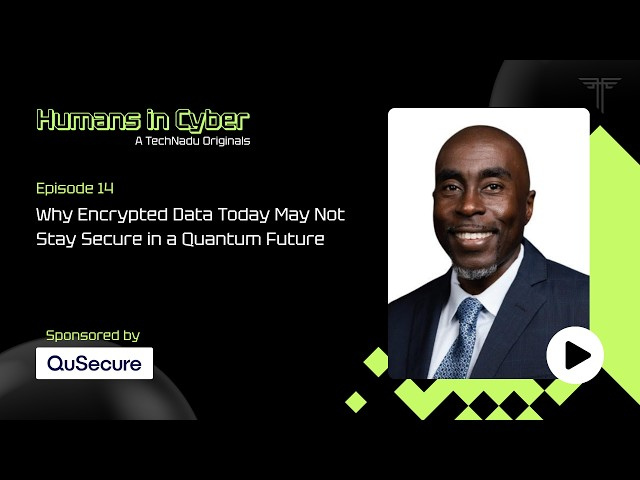
“I think harvest now, decrypt later is one of the risks that we see is really happening and is being underestimated. I think also the timeline, people don’t realize transition takes a lot of time, and money, and effort.” – Dr. Garfield Jones.
In a recent episode of Humans in Cyber on TechNadu, Dr. Garfield Jones, Senior Vice President, Research and Technology Strategy at QuSecure, discusses the core risks surrounding encryption as quantum computing advances. While awareness is increasing across government and enterprise environments, execution remains inconsistent and delayed. The gap between perceived readiness and actual preparedness leaves many organizations exposed.
Key Takeaways
Jones highlights several risks teams are underestimating.
- “Harvest now, decrypt later” attacks: Adversaries are collecting encrypted data today to later decrypt it with a quantum computer.
- Unmanaged cryptographic inventory: Many organizations still rely on outdated cryptography and deprecated algorithms across systems.
- Migration timelines: Transitions are costly and time-intensive, but architecture and products that avoid rip-and-replace approaches will greatly reduce costs.
For security leaders, migrating from TLS 1.2 to 1.3 offers a practical start without requiring a full system overhaul.
Why This Matters Now
Google’s 2029 timeline signals that the migration to post-quantum cryptography is accelerating. CNSA 2.0 requires a phased shift to quantum-resistant cryptography, establishing a deadline of January 1, 2027, for the acquisition of new National Security Systems (NSS). However, many government and enterprise organizations haven’t transitioned their cryptographic assets to FIPS 203, 204, and 205 standards. Many teams assume their encryption is holding up when, in reality, they lack visibility into where cryptography lives in their systems or whether it is outdated.
The problem isn’t in awareness, but in delayed action.
Watch the Full Discussion
To learn about post-quantum readiness, what risks organizations are underestimating, and why acting now is critical, watch the full discussion on TechNadu.