Change the cryptography across your network without changing your applications
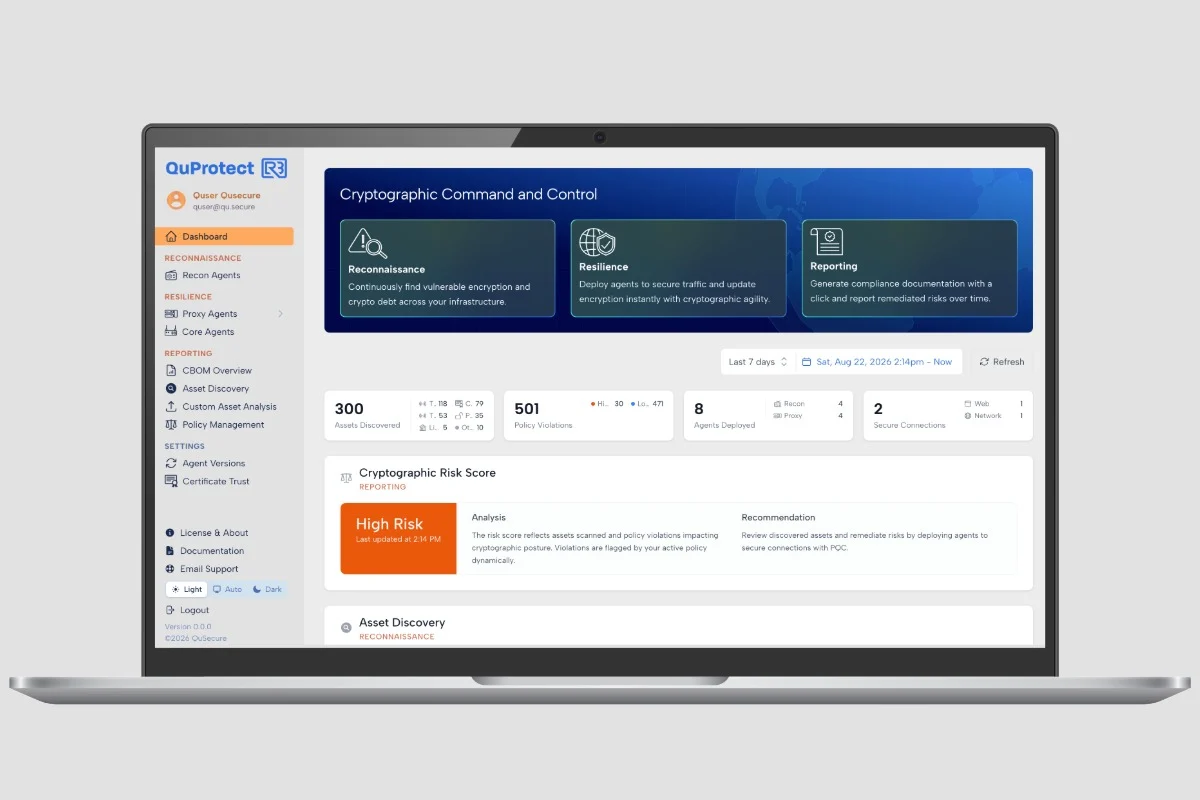
QuProtect R3 is a software-only post-quantum cryptography platform. It discovers the cryptography you are running, protects it at the network layer, and proves it with a CBOM.
Each links to its definition, with the source it came from.
All termsRSA and ECC are on borrowed time
The cryptography protecting you today was built for a different era. RSA and ECC secure much of today's sensitive data, identities, software, and network traffic. They work because today's computers cannot realistically break them. Quantum computers change that equation.
The risk starts before a cryptographically relevant quantum computer arrives. Adversaries can collect encrypted data now to decrypt later, while federal mandates are already pushing organizations toward post-quantum migration. The challenge is knowing where vulnerable cryptography exists, changing it without disrupting critical systems, and proving the migration is complete.
QuProtect R3 helps organizations do all three: find it, change it by policy, and prove it.
What it is, and what it is not
- QuProtect R3 is
- Software-only. No new hardware, no quantum computer.
- QuProtect R3 is not
- Not QKD. QuProtect applies NIST PQC to your network, it does not use quantum technology itself.
- QuProtect R3 is
- A network-layer service mesh. It adds NIST post-quantum cryptography (PQC) to connections you already run.
- QuProtect R3 is not
- Not a discovery point tool. Discovery is one of three pillars, and it feeds remediation.
- QuProtect R3 is
- Centrally orchestrated. One Orchestrator for discovery, protection and reporting across your network.
- QuProtect R3 is not
- Not an application rewrite. No code changes and no library swaps inside your applications.
- QuProtect R3 is
- Complementary. It sits alongside your EDR, SIEM, CASB and certificate manager, and covers what none of them were built to see.
- QuProtect R3 is not
- Not data-at-rest encryption. QuProtect protects data in transit. Disk and database encryption stay with your existing controls.
Three pillars of one platform
Discovery feeds remediation, and remediation is what the reporting proves.
-
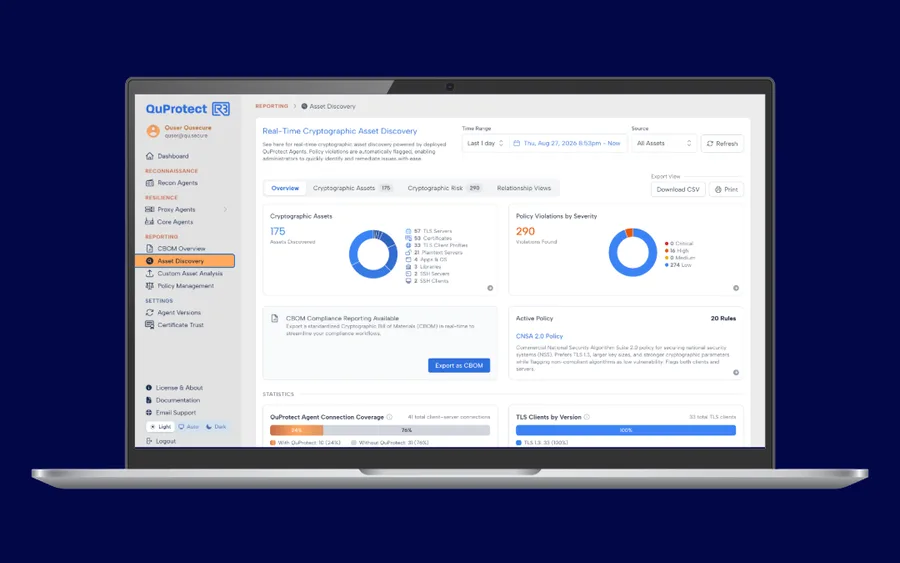
Discovery
QuProtect Recon
Find where legacy cryptography is still in use, on live network traffic, ranked by exposure rather than by count.
Cryptographic discovery and inventory
-
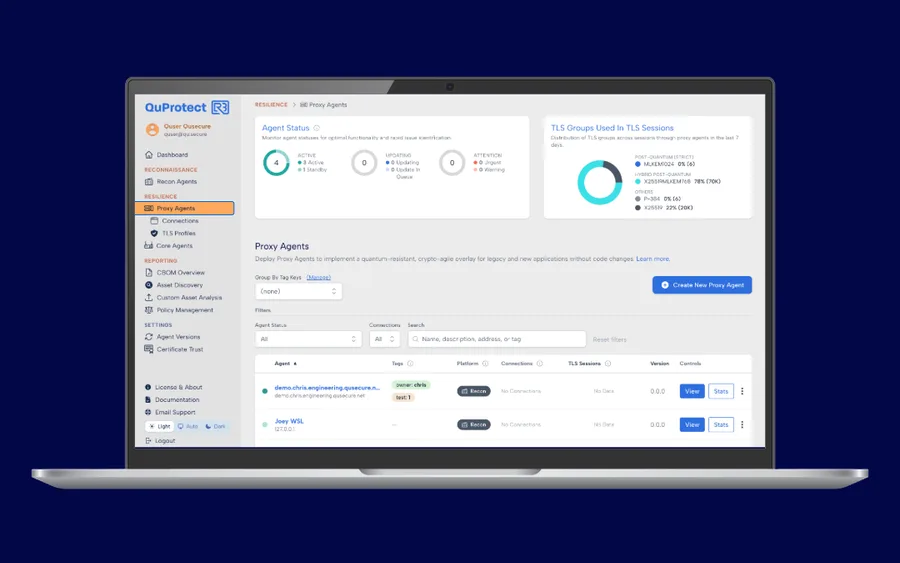
Remediation
QuProtect Resilience
Change what those systems negotiate, by policy, without code changes.
Crypto-agility and remediation
-
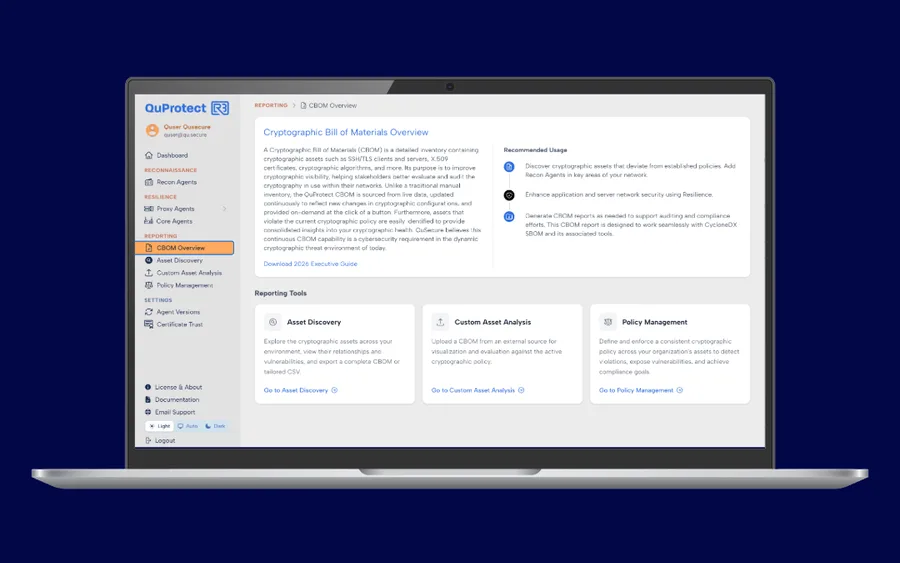
Compliance
QuProtect Reporting
Produce the audit-ready CycloneDX CBOM your auditor asks for.
CBOM and compliance
The cryptographic policy engine
-
An administrator sets a policy in the Orchestrator: which algorithm, and where it applies.
-
The Orchestrator distributes that policy to every encryptor in scope.
-
Encryptors renegotiate connections on the new algorithm while traffic keeps flowing.
An encryptor deploys as a sidecar alongside a workload, forming a service mesh, or as a gateway serving multiple endpoints. NIST CSWP 39-upd1 describes both: section 4.3, "Using Service Mesh in Cloud-Native Environments", and section 4.6, "Using a Crypto Gateway for Legacy Systems". Applications, the network and the infrastructure underneath are not replaced.
Technical specifications
Algorithms
- ML-KEM (NIST FIPS 203) key encapsulation, including ML-KEM-1024 for CNSA 2.0 Why ML-KEM
- ML-DSA (NIST FIPS 204) signatures, for example ML-DSA-65
- SLH-DSA (NIST FIPS 205) hash-based signatures
- Hybrid post-quantum TLS: X25519MLKEM768 Why hybrid
- Classical interoperability: P-256, RSA, X25519
- FIPS 140-3 mode of operation
Protocols and components
- PQ-TLS and PQ-mTLS, with classical TLS fallback
- TLS 1.3, IPsec, TCP, gRPC and HTTP
- JA3 and JA4 TLS client fingerprinting
- Sensors and encryptors under one Orchestrator
- Sidecar service mesh or gateway data plane
- Automated certificate provisioning and rotation
Platform and compliance
- Cloud, hybrid, on-premises and air-gapped, without re-architecting
- DoD Impact Level 2, with IL6 authorization sponsored and in progress
- CNSA 2.0 aligned What CNSA 2.0 requires
- CycloneDX v1.6 CBOM What a CBOM contains
- Supports PCI DSS 4.0 cryptographic inventory requirements What 12.3.3 asks for
- Supports federal cryptographic inventory requirements Mapped to M-26-15
- Integrations: select vulnerability scanners, SIEM and SOAR
Validated in production
Live post-quantum sessions over legacy satellite links, on endpoints that could not be modified. CNSA 2.0 readiness proven to auditors in one quarter, starting with no inventory. Three customers have published the detail.
- 2026 Technology Pioneer, World Economic Forum
- Gold, International Business Awards, 2026
- No. 526 on the 2026 Inc. 5000
-
Banco Sabadell
Banco Sabadell validated post-quantum TLS on customer-facing infrastructure in four months, and the SEC cited the pilot as an industry benchmark.
Read the case study
-
Global Telco TLS Migration
A Tier-1 operator deployed post-quantum TLS across existing infrastructure without rewriting legacy applications, against years of cryptographic debt.
Read the case study
-
Oil & Gas Critical Infrastructure
A multi-national oil company validated post-quantum encryption for exploration data in a production-equivalent environment, covering geological surveys that stay commercially sensitive for 20 years and SCADA systems with no application-level migration path. The pilot won production approval and a multi-year rollout budget.
Read the case study
Frequently asked questions
-
What does QuSecure's QuProtect R3 actually do?
QuProtect R3 discovers the cryptography in use across a network, changes it to NIST post-quantum algorithms by policy at the network layer without application code changes, and generates a CycloneDX cryptographic bill of materials on demand.
-
Is QuProtect quantum key distribution (QKD)?
No. QuProtect R3 uses NIST post-quantum algorithms implemented in software, and it does not use quantum key distribution, so it needs no dedicated optical link, no quantum hardware and no quantum computer.
-
How do you inventory all the cryptography across an organization?
QuProtect sensors observe live network traffic passively and build an inventory of the algorithms, protocols, certificates and key sizes in use.
-
Do I need to rewrite any code to make my applications quantum-safe?
No. The change happens at the network layer. Encryptors carry connections over post-quantum TLS 1.3, so the algorithms a system negotiates change without modifying application source code or swapping cryptographic libraries.
-
What does changing cryptography by policy mean in practice?
An administrator sets a policy in the QuProtect Orchestrator specifying which algorithm applies and where. The Orchestrator distributes that policy to every encryptor in scope, and those encryptors renegotiate connections on the new algorithm.
-
How do you generate a CBOM automatically?
QuProtect Reporting generates a CycloneDX v1.6 cryptographic bill of materials from the live inventory the sensors build, on demand and in machine-readable form. A CBOM is to cryptography what an SBOM is to software components: a list of what is present in the environment, exportable for an auditor or a federal cryptographic inventory submission.
-
Where does QuProtect fit alongside my existing security tools?
QuProtect is complementary. EDR, SIEM, CASB and certificate lifecycle managers were not built to inventory or change the cryptography negotiated on the wire, which is the gap QuProtect covers.
-
What does deployment require, and what does it change?
Sensors deploy. Encryptors deploy as a sidecar alongside a workload, forming a service mesh, or as a gateway serving multiple endpoints. NIST CSWP 39-upd1 describes both: section 4.3, “Using Service Mesh in Cloud-Native Environments”, and section 4.6, “Using a Crypto Gateway for Legacy Systems”. Applications, the network and the infrastructure underneath are not replaced.
-
Does QuProtect only address quantum risk?
No. Crypto-agility addresses cryptographic risk that is already present: expiring certificates, weak ciphers, deprecated TLS versions and shadow cryptography nobody has inventoried. It also shortens the response time to AI-accelerated cryptanalysis, because an algorithm change is a policy update rather than an engineering project.
-
Which NIST post-quantum algorithms does QuSecure support?
ML-KEM under FIPS 203, including ML-KEM-1024 for CNSA 2.0 alignment; ML-DSA under FIPS 204; SLH-DSA under FIPS 205; and hybrid post-quantum TLS via X25519MLKEM768.
-
Does QuProtect hold FIPS 140-3 validation or FedRAMP authorization?
QuProtect R3 supports a FIPS 140-3 mode of operation and runs at DoD Impact Level 2. The DoD Cloud Computing Security Requirements Guide aligns that level with the FedRAMP Moderate baseline. Impact Level 6 authorization is in progress, sponsored through an Air Force TACFI award.
-
Does QuProtect work in cloud environments?
Yes. QuProtect runs in cloud, hybrid, on-premises and air-gapped environments. In cloud-native environments the encryptors form a service mesh, which is the approach NIST CSWP 39-upd1 section 4.3 describes.
-
How do federal agencies buy QuProtect?
QuProtect R3 is available on Carahsoft’s GSA Multiple Award Schedule under contract 47QSWA18D008F, and through SEWP V, ITES-SW2, NASPO ValuePoint and OMNIA Partners.
Terms on this page
-
Air gap
An interface between two systems that are not physically connected and where any logical connection is manual rather than automated. An air-gapped environment cannot reach a vendor’s cloud, so anything deployed into one has to work without calling home.
Source: NIST , NIST SP 800-53 Rev. 5 (csrc.nist.gov)
-
CASB Cloud access security broker
Software that sits on the network between cloud service customers and cloud service providers, enforcing enterprise security policy on traffic that leaves the corporate perimeter. It is one of the tools an enterprise already runs, and it inspects access to cloud services rather than the cryptography those connections negotiate.
Source: NIST , NIST SP 800-215 (csrc.nist.gov)
-
CBOM Cryptographic Bill of Materials
A structured inventory of the cryptographic assets in a system: the algorithms, keys and certificates in use, and how they relate to the software components that use them. CycloneDX, which publishes the format, calls it a Cryptography Bill of Materials.
Source: OWASP CycloneDX , CycloneDX v1.6 (cyclonedx.org)
-
CNSA Commercial National Security Algorithm Suite
A specific set of cryptographic algorithms and key strengths that may be used to protect classified and unclassified national security systems. The suite was announced in 2015, replacing the former release of Suite B algorithms; CNSA 2.0 is the current revision.
Source: NIST , CNSSI 4009-2022 (csrc.nist.gov)
-
Cryptographic agility
The capabilities needed to replace and adapt cryptographic algorithms in protocols, applications, software, hardware, firmware and infrastructures while preserving security and ongoing operations. It is the property that makes a migration a configuration change rather than a rebuild.
Source: NIST , NIST CSWP 39-upd1 (csrc.nist.gov)
-
Cryptographic module
The set of hardware, software or firmware that implements approved cryptographic functions, including key generation, within the module’s cryptographic boundary. The module, rather than the product around it, is the unit FIPS 140-3 describes.
Source: NIST , FIPS 140-3 (csrc.nist.gov)
-
EDR Endpoint detection and response
A device-management safeguard that watches endpoints for malicious activity and responds to it. NIST lists it beside mobile device management as a control for the risks of mobile and remote computing; like a CASB, it looks at the endpoint rather than at the cryptography a connection negotiates.
Source: NIST , NIST SP 800-66r2 (csrc.nist.gov)
-
FedRAMP Federal Risk and Authorization Management Program
A governmentwide program providing a standardized approach to security assessment and authorization for cloud products and services used by U.S. federal agencies. An agency buying a cloud service generally expects it to hold a FedRAMP authorization at a baseline matching the sensitivity of the data involved.
Source: FedRAMP , FedRAMP program overview (www.fedramp.gov)
-
FIPS Federal Information Processing Standards
A standard for adoption and use by federal departments and agencies, developed within NIST’s Information Technology Laboratory. A FIPS covers a specific topic in information technology to achieve a common level of quality or some level of interoperability. The post-quantum algorithms are published as FIPS 203, 204 and 205.
Source: NIST , NIST SP 1800-12b (csrc.nist.gov)
-
IL6 DoD Impact Level 6
The level of the DoD Cloud Computing Security Requirements Guide reserved for information classified up to SECRET. The SRG is maintained by DISA and defines the baseline a cloud service is assessed against; an IL6 provisional authorization builds on a FedRAMP High authorization supplemented with DoD-specific controls, and the infrastructure must be dedicated and operated under contract to the DoD or a federal agency.
Source: Microsoft , DoD Impact Level 6, citing Cloud Computing SRG sections 5.1.1 and 5.2.2.4 (learn.microsoft.com)
-
KEM Key-encapsulation mechanism
A set of three cryptographic algorithms (KeyGen, Encaps and Decaps) that two parties use to establish a shared secret key over a public channel. It is the shape most post-quantum encryption takes, which is why the standardized algorithm is named ML-KEM rather than being described as an encryption scheme.
Source: NIST , FIPS 203 (csrc.nist.gov)
-
ML-DSA Module-Lattice-Based Digital Signature Algorithm
NIST’s standardized post-quantum digital signature algorithm, published as FIPS 204. Signatures prove where data came from rather than keeping it secret, so ML-DSA is what replaces the signing side of a certificate chain.
Source: NIST , FIPS 204 (csrc.nist.gov)
-
ML-KEM Module-Lattice-Based Key-Encapsulation Mechanism
NIST’s standardized post-quantum key-encapsulation mechanism, published as FIPS 203. It is the algorithm that replaces the key exchange in protocols like TLS, and its security rests on lattice problems rather than on the factoring and discrete-logarithm problems a quantum computer can solve.
Source: NIST , FIPS 203 (csrc.nist.gov)
-
mTLS Mutual Transport Layer Security
TLS in which both ends authenticate, not just the server. The server sends a
CertificateRequestwhen certificate-based client authentication is wanted, and omits it when it is not; mTLS is the arrangement where it is always sent, so each side proves who it is.Source: IETF , RFC 8446: TLS 1.3, section 4.3.2 (www.rfc-editor.org)
-
PQC Post-quantum cryptography
Cryptography designed to secure electronic information against the future threat of quantum computers, which could eventually break many of today’s widely used cryptographic systems. PQC runs on ordinary hardware; NIST released the principal three standards in 2024 as ML-KEM, ML-DSA and SLH-DSA.
Source: NIST , NIST Post-Quantum Cryptography project (csrc.nist.gov)
-
QKD Quantum key distribution
A method for two parties to agree a shared key using the properties of quantum mechanics, carried over a dedicated optical link; ITU-T Y.3800 describes the networks that support it. QKD is not post-quantum cryptography, which is software running on ordinary hardware, and QuProtect uses the latter.
Source: ITU-T , ITU-T Y.3800: Overview on networks supporting quantum key distribution (www.itu.int)
-
R3 QuProtect R3
QuSecure’s post-quantum cryptography platform. The R3 is its three capabilities: Recon discovers the cryptography an organization is running, Resilience changes it at the network layer by policy, and Reporting proves what changed with a CBOM.
-
SIEM Security information and event management
A program that provides centralized logging capabilities for a variety of log types. A SIEM is usually where a security team already looks, which is why cryptographic findings are worth sending to one rather than to a separate console.
Source: NIST , NIST SP 800-92 (csrc.nist.gov)
-
SLH-DSA Stateless Hash-Based Digital Signature Algorithm
NIST’s standardized hash-based post-quantum signature algorithm, published as FIPS 205. Its security rests on hash functions rather than on lattices, so it is the alternative to ML-DSA for anyone who wants a second signature scheme built on different mathematics.
Source: NIST , FIPS 205 (csrc.nist.gov)
-
SOAR Security orchestration, automation, and response
Tooling that continuously monitors log events for known malicious and suspicious activity and generates reports on what it finds, alongside a SIEM. NIST names both as the tools behind a proactive approach to incident detection and response.
Source: NIST , NIST SP 800-61r3 (csrc.nist.gov)
Bring crypto-agility to your network.
Book a technical session and see QuProtect R3 against your own architecture.